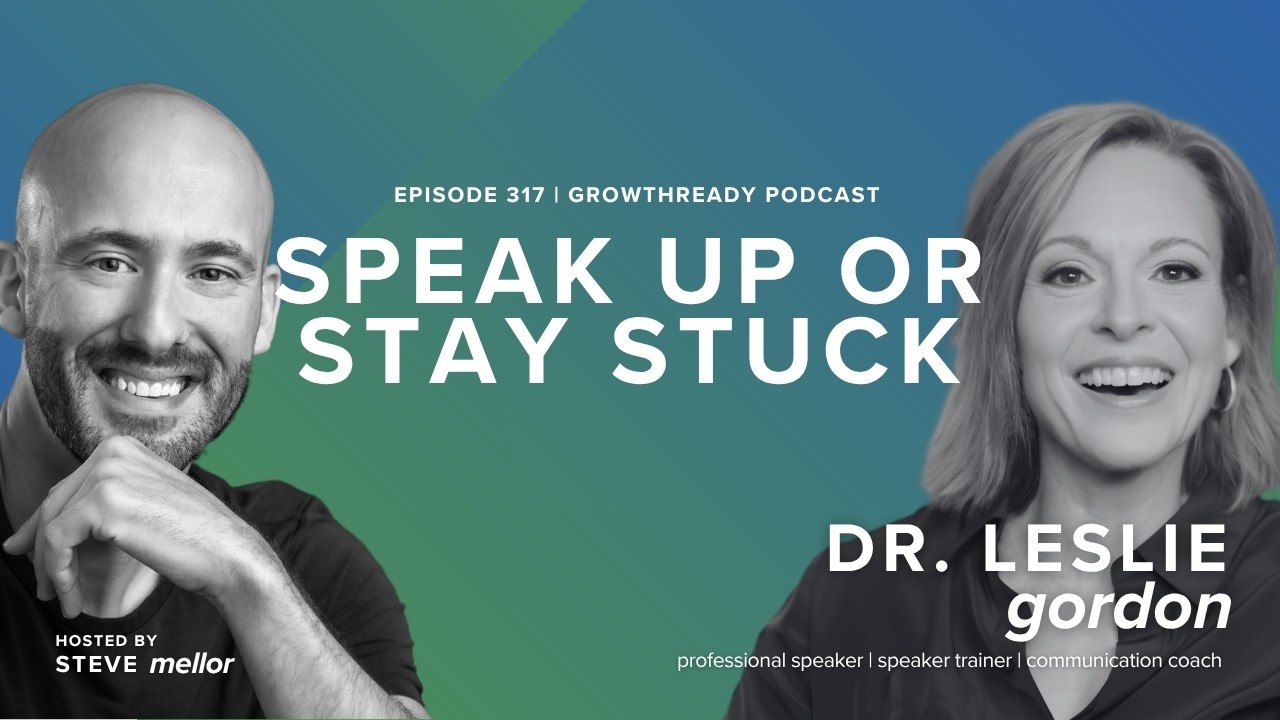
The Growing Edge: Why Your Expertise Isn’t Enough Until Your Voice Can Carry It
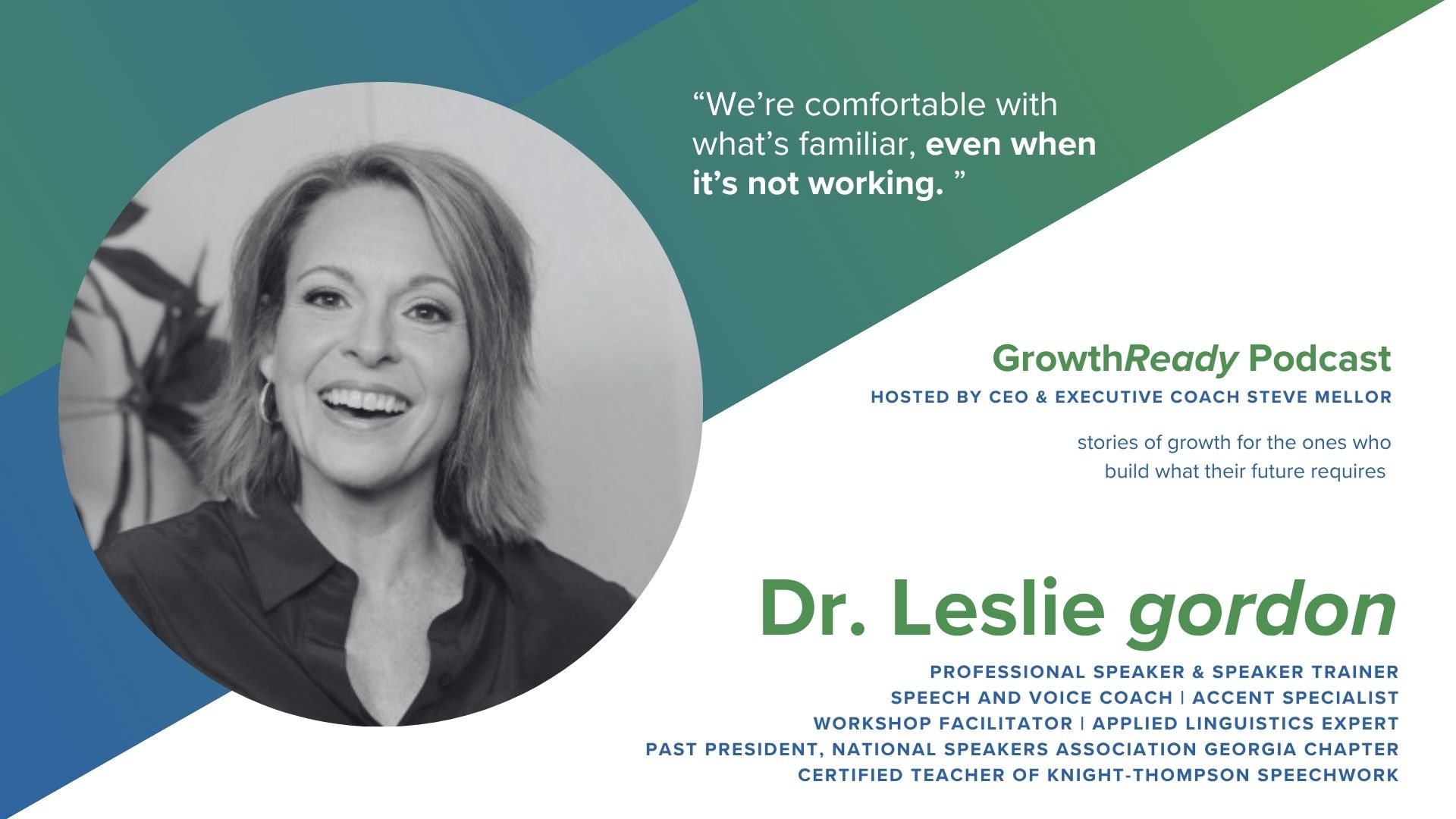
There comes a point in every high performer’s journey where talent is no longer the question.
You know the work.
You have the experience.
You have earned the room.
And yet, somewhere between what you know and what others receive, something gets lost.
That gap is where Dr. Leslie Gordon’s work lives.
In this conversation, Leslie introduced a phrase that immediately deserves a place in every growth-minded professional’s vocabulary: the growing edge. Not weakness. Not failure. Not something broken inside of you. A growing edge, the place where your next level is asking you to stretch, act, and become more intentional.
And that distinction matters.
Because too often, high performers are trained to label anything uncomfortable as a flaw.
“I’m not good at speaking.”
“I’m not confident in that room.”
“I know what I mean, but I can’t seem to land it.”
“I should be better at this by now.”
But Leslie challenges that thinking.
What if the thing you have been calling a weakness is actually the next edge of your growth?
The Disconnect High Performers Quietly Carry
One of the most powerful insights from this conversation was Leslie’s observation about high-achieving professionals.
Many have reached a level where their expertise is undeniable. They know the subject. Their peers know they know it. Their organization knows they know it.
But their voice has not yet grown to reflect the depth of that expertise.
That is a painful place to live.
Because when your ideas are strong but your voice does not fully carry them, it can feel like your impact is trapped behind an invisible wall.
You leave meetings thinking, “I should have said that.”
You hear someone else make the point you had already formed in your head.
You know you had value to add, but the moment passed.
That is not a lack of intelligence.
It is not a lack of ambition.
It is often a lack of alignment between the expertise you have built and the voice required to express it.
And for high performers, that gap can become what Leslie called “a blister on identity.” You can still progress, still achieve, still be respected, but the discomfort remains because you know there is more available to you.
Evaluate the Evaluation
High performers are usually highly self-evaluative.
That can be a gift.
Self-awareness helps us improve. It allows us to notice habits, refine our performance, and take responsibility for how we show up.
But self-evaluation can also become the obstacle.
There is a difference between useful evaluation and constant self-criticism.
Useful evaluation asks:
“What can I learn from this?”
Self-criticism asks:
“What is wrong with me?”
That distinction is everything.
Leslie made the point clearly: we need to evaluate the evaluation. Is the voice in your head helping you grow, or is it keeping you quiet? Is it creating awareness, or is it creating paralysis?
Because when the internal noise gets too loud, presence becomes almost impossible.
And presence is not an accident.
Presence is built through awareness, intention, and the ability to redirect your attention toward what actually matters.
The Voice in Your Head Is Trying to Protect You
One of the most human parts of the conversation came when Leslie talked about the inner voice.
That voice that says:
“Don’t speak up.”
“You’re not ready.”
“Wait until next time.”
“You might embarrass yourself.”
At first glance, it sounds like criticism.
But Leslie reframed it beautifully: that voice often begins as a mechanism of safety. It is trying to protect you from discomfort, exposure, or embarrassment.
The problem is that safety and growth rarely live in the same place.
At some point, the voice that once protected you can begin to limit you.
So the work is not to pretend the voice does not exist. The work is to change your relationship with it.
Leslie even offered a practical strategy: give that voice a name.
Name it to tame it.
By naming it, you create distance from it. You stop letting it lead the room. You stop treating every anxious thought as truth.
You begin to realize:
I can hear the voice without obeying it.
That is a powerful shift.
You Cannot Connect and Critique at the Same Time
This may have been the strongest takeaway of the entire conversation:
You cannot connect and critique at the same time.
Read that again.
Because for high performers, this is a game-changer.
If you are in a meeting, presentation, conversation, or high-stakes moment and your attention is consumed by self-monitoring, you are no longer fully available for connection.
You are not focused on the person in front of you.
You are not grounded in the value of your message.
You are not serving the room.
You are managing yourself.
Leslie’s insight was that the voice becomes more powerful when it becomes other-focused.
When you speak from service, the question changes.
It is no longer:
“How am I being perceived?”
It becomes:
“Who needs this message, and how can I help it land?”
That shift moves you out of performance anxiety and into purpose.
And purpose has a way of creating presence.
Confidence Is Not a Jacket You Put On
There is a lazy piece of advice people give all the time:
“Just be confident.”
But what does that actually mean?
Confidence is not something you magically decide to wear one day. It is not a jacket you throw on before walking into a difficult room.
Confidence is built.
It is built through action.
It is built through repetition.
It is built through trying something, feeling awkward, surviving it, learning from it, and doing it again.
This is where Leslie’s concept of the growing edge becomes so important.
Growth mindset is not enough if it never becomes action.
You can believe in growth and still avoid the discomfort required to grow.
You can say, “I want to improve,” while staying safely inside familiar habits.
The edge is where the work begins.
And the first step does not have to be massive.
In fact, Leslie encourages low-stakes practice. Give yourself a “freebie.” Try something badly. Experiment. Let the first attempt be imperfect.
That is how new patterns are built.
Not by waiting until you feel confident.
By acting before confidence has fully arrived.
Your Body Is Part of the Message
Leslie also brought the conversation into the body, which is where so much of our communication actually lives.
Your voice is not separate from your physical state.
If your body is tense, rushed, braced, or chaotic, your voice will likely carry that.
You may be trying to sound calm, but your voice may be communicating urgency.
You may be trying to inspire trust, but your pace may be creating nervousness.
You may be trying to establish authority, but your body may still be operating from the energy of someone trying to prove they belong.
The body, mind, and voice are always in conversation.
That means your growth is not just about saying better words.
It is about creating the physical conditions for your message to land.
Breath matters.
Pace matters.
Listening matters.
Space matters.
Sometimes the strongest person in the room is not the one fighting to speak first.
Sometimes it is the one who listens fully, waits intentionally, and speaks when the contribution is useful.
That kind of presence does not need to force its way into the room.
It already belongs there.
Growth Happens Better in Community
Toward the end of the conversation, Leslie brought the work back to community.
And this matters deeply.
Because high performers are often tempted to do the work alone.
Lock the door.
Study the skill.
Fix the issue.
Come back polished.
But some growth cannot happen in isolation.
You need people to reflect back what you cannot see. You need safe environments where you can practice, stumble, adjust, and try again. You need rooms where others are also working their edge, because that shared discomfort creates trust.
Leslie quoted Les Brown with a line worth remembering:
“You can’t read the label from inside the jar.”
That is the gift of community.
It helps you see what you cannot see from the inside.
It reminds you that your edge is not something to hide. It is something to grow.
The Real Question
The challenge from this conversation is not simply, “Do I need to speak better?”
The deeper question is:
Where has my voice not yet caught up to my growth?
Maybe it is in a boardroom.
Maybe it is on a stage.
Maybe it is in a difficult conversation.
Maybe it is in the moments where you know the insight is there, but you keep choosing silence.
Wherever it is, that place is not proof that you are weak.
It may be the exact edge where your next level begins.
So stop asking whether you are good or bad at it.
Start asking what action will help you grow it.
Because the next version of you will not be built by staying comfortable.
It will be built at the edge.
CEO of GrowthReady
Olympic swim coach turned high-performance strategist, Steve helps top leaders gain clarity, elevate performance, and lead with purpose. As founder of GrowthReady and host of the GrowthReady Podcast, Steve brings real-world strategies and straight-talk coaching to help you unlock your full potential.
-Featured on top leadership podcasts
-The GrowthReady Podcast Host
-Author of Shock the World: A Competitor's Guide to Realizing Your Potential
-Former Olympic-level coaching expertise applied to executive development

Stop Boxing In Your Life: What Kendall Breitman Teaches Us About Growth, Trust, and Community