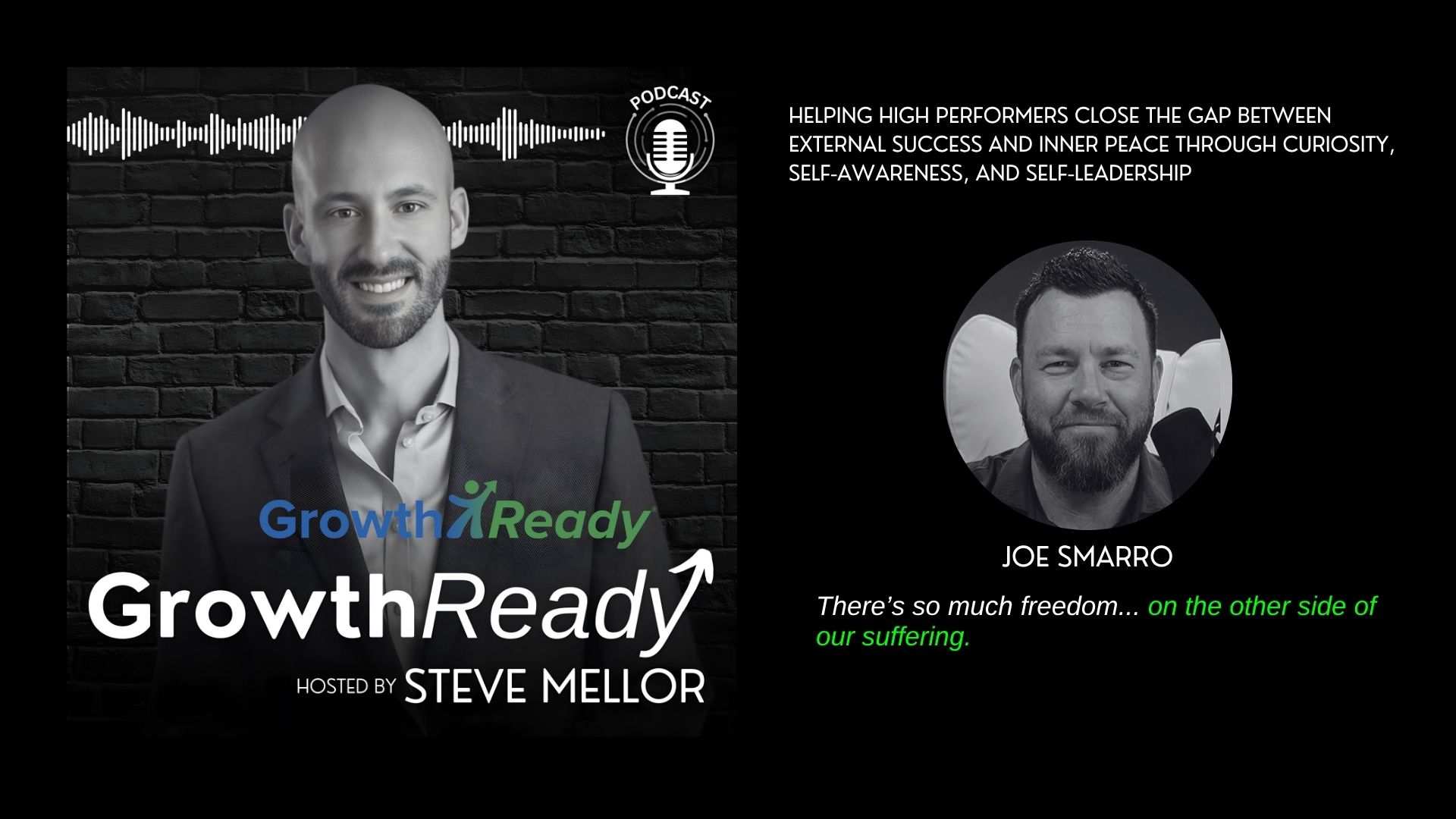
Helping High Performers Close the Gap Between External Success and Inner Peace Through Curiosity, Self-Awareness, and Self-Leadership
There’s a version of success that looks strong from the outside and feels hollow on the inside.
A lot of high performers know exactly what I mean.
You can be respected, productive, driven, accomplished, and still find yourself sitting alone at the end of the day wondering why none of it feels the way you thought it would. You can be winning in public while quietly battling what shows up in private. In my recent conversation on the GrowthReady Podcast with Joe Smarro, we went straight at that tension, and it turned into one of the most honest conversations I’ve had about performance, identity, and personal growth.
What hit me most was this:
Growth starts when you get curious enough to tell yourself the truth.
Joe defined being “growth ready” as a constant state of curiosity rooted in self-awareness and introspection. Not surface-level curiosity. Not motivational fluff. Real curiosity. The kind that asks:
Why do I believe what I believe?
Why do I react the way I react?
Why do I keep choosing what I say I don’t want?
Why is there such a gap between the version of me I perform out in the world and the version of me I sit with when no one else is around?
That gap is where so many people live.
It’s the gap between the representative self and the real self. The version you know how to present, and the version you still need to heal. The version that gets applause, and the version that still wrestles with fear, shame, insecurity, and the need for external validation.
And if you’re serious about high performance, that gap matters.
Because sooner or later, performance built on disconnection catches up with you.
One of the most powerful ideas Joe shared was that so much of what we call identity is inherited. Beliefs about success, relationships, money, love, work, and worth often come from family, school, culture, community, and environment long before we ever examine whether those beliefs are actually ours. We spend years living according to patterns we never consciously chose, then wonder why we feel trapped inside a life that no longer fits.
That’s not a motivation problem.
That’s an awareness problem.
And the fix is not “try harder.”
The fix is to slow down long enough to ask better questions.
Joe challenged this beautifully through what he called selfishness, but not the kind most people think of. Not ego. Not entitlement. Not self-absorption. He was talking about the kind of selfishness that says:
I am responsible for knowing myself.
I am responsible for honoring what matters to me.
I am responsible for not abandoning myself just to keep everyone else comfortable.
That landed with me.
Because too many people are not failing from lack of discipline. They’re suffering from misalignment.
They’re staying in careers they don’t love because they’ve convinced themselves it’s “too late.”
They’re saying yes when they mean no.
They’re performing for approval instead of living from conviction.
They’re denying themselves the very life they say they want, then calling it responsibility.
That’s not responsibility. That’s quiet self-betrayal.
Joe spoke about people becoming prisoners to pensions, expectations, titles, and identities. He talked about how easy it is to build a life around what looks right from the outside, while feeling disconnected from it on the inside. And as we unpacked that idea, something became incredibly clear to me:
The goal is not to blow up your life overnight. The goal is to stop abandoning yourself inside it.
That’s an important distinction.
Not everyone needs to quit their job.
Not everyone needs to start a business.
Not everyone needs to make a dramatic move.
But everyone does need to ask:
Where am I out of alignment?
Where am I denying myself?
Where am I waiting for external validation to give me what I should be building internally?
Joe shared a framework he uses to assess his life through four pillars: health, wealth, spirituality, and relationships.
I love that because it pulls growth back to what actually matters.
Not image.
Not titles.
Not applause.
Not output for output’s sake.
Just honest assessment.
How am I doing in my health?
How am I doing in my relationships?
How am I doing spiritually?
How am I doing in the way I build, manage, and steward my life?
That kind of reflection is powerful because it forces you to stop measuring your life by other people’s scorecards.
And that’s where real growth begins.
Another moment that stayed with me was Joe sharing an exercise a mentor gave him: write your obituary.
It’s a hard exercise. It’s also a necessary one.
Because when you look at your life from the end, clarity shows up fast.
Suddenly, the things that consume your stress today may not even make the page. The rejection you’re afraid of. The opinion you’re managing. The role you’re clinging to. The comfort you’re hiding inside. A lot of it loses its grip when you ask a bigger question:
How do I want to be remembered?
Joe said if he could have one word on his tombstone, it would be love.
That’s not soft. That’s strong.
It takes strength to love yourself enough to change.
It takes courage to tell the truth about your life.
It takes discipline to close the gap between your values and your behavior.
It takes maturity to realize that high performance without inner alignment is a dangerous game.
That’s why this conversation matters.
Because the highest-performing people I know are not the ones who have it all figured out. They’re the ones willing to face themselves honestly. They don’t chase growth as a finish line. They pursue it as a way of living. They understand that there is no final arrival, only a deeper commitment to becoming.
That’s the invitation here.
Get curious.
Take inventory.
Name the gap.
Stop waiting for permission.
Stop outsourcing your worth.
Stop building a life that looks good but feels disconnected.
And most importantly, stop underestimating what’s possible on the other side of the work you’ve been avoiding.
There is freedom there.
Not ease. Not comfort. But freedom.
Freedom to speak up.
Freedom to say no.
Freedom to lead with more conviction.
Freedom to perform from alignment instead of fear.
Freedom to build a life that actually feels like yours.
That’s a version of growth worth pursuing.
Here’s my challenge to you:
Take 15 minutes today and ask yourself one question:
What is the gap between the life I’m performing and the life I actually want to live?
Do not rush the answer.
That question might change more than you think.
Ready to do the work?
Book a discovery call with Steve Mellor and let’s talk about how to close the gap between where you are and who you know you’re capable of becoming.
Want the full conversation?
Listen to the full podcast episode for the deeper insights, tougher questions, and the kind of perspective shift that can change the way you lead, perform, and live.
CEO of GrowthReady
Olympic swim coach turned high-performance strategist, Steve helps top leaders gain clarity, elevate performance, and lead with purpose. As founder of GrowthReady and host of the GrowthReady Podcast, Steve brings real-world strategies and straight-talk coaching to help you unlock your full potential.
-Featured on top leadership podcasts
-The GrowthReady Podcast Host
-Author of Shock the World: A Competitor's Guide to Realizing Your Potential
-Former Olympic-level coaching expertise applied to executive development

Helping Leaders Communicate With More Power and Presence Through Embodied Readiness

