Helping Leaders Communicate With More Power and Presence Through Embodied Readiness
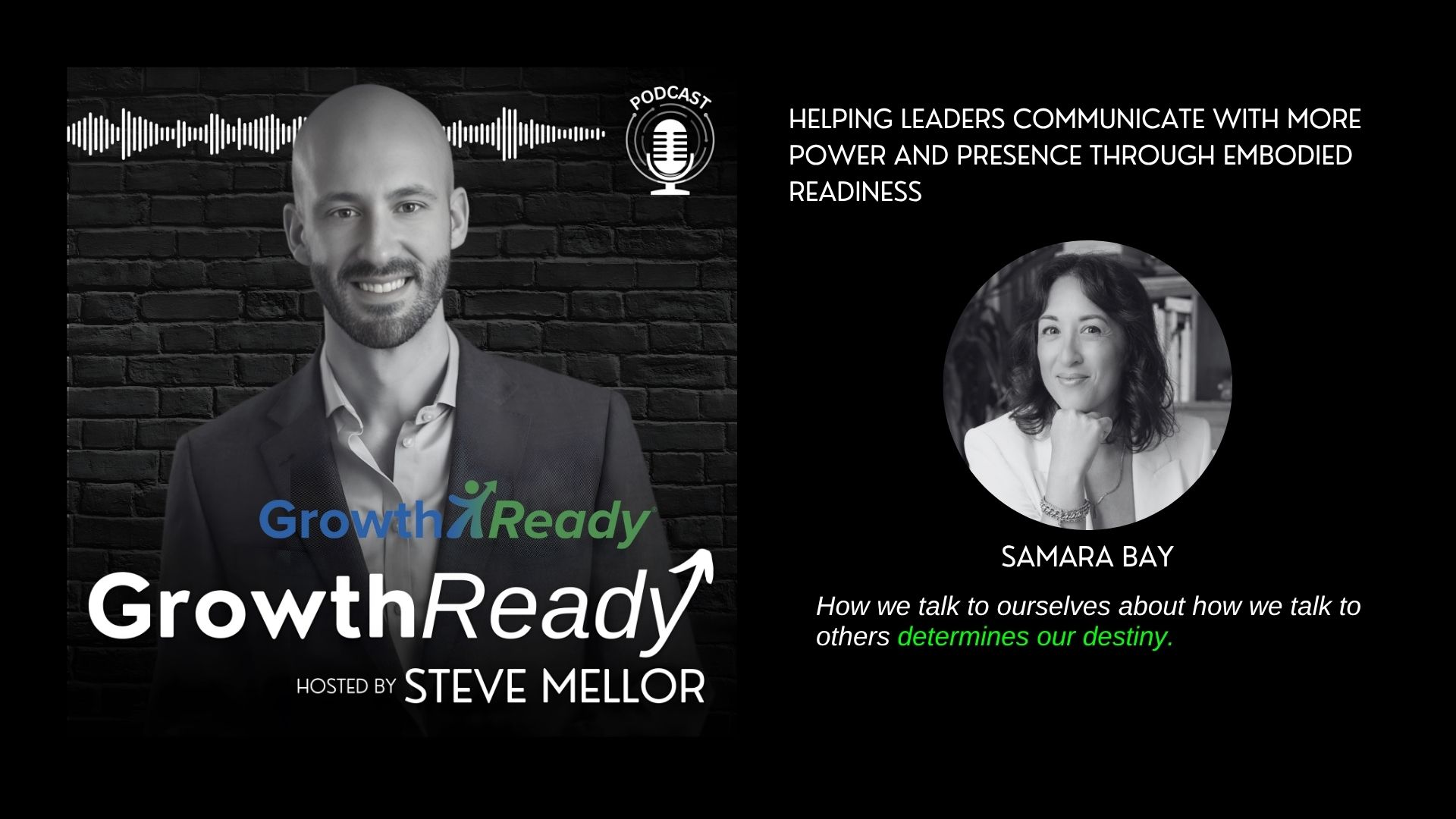
There are some podcast conversations that give you practical insight.
And then there are conversations that quietly rewire the way you think about leadership, communication, and growth itself.
This was one of those.
On GrowthReady, I sat down with Samara Bay, and from the very beginning, she challenged the way most of us think about readiness. Her point was simple, but not easy: readiness is not just a mental state. In many ways, it is a body state. And if we are waiting to feel perfectly ready in our minds before we speak, lead, or step forward, we may actually be waiting forever.
That landed with me immediately.
Because so many high-performers are trying to think their way into confidence.
They are trying to out-strategize nerves.
Out-reason fear.
Outperform discomfort.
But Samara’s message was different.
She talked about readiness as something that lives in the body first, in ritual, in movement, in a warm-up, in what she called getting “wiggly” enough to come alive and be available for the unknown. That idea might sound playful on the surface, but underneath it is a serious leadership lesson: growth does not come from perfection. It comes from being physically and emotionally available to what the moment requires.
That is a powerful reframe for leaders, entrepreneurs, and anyone trying to show up well in high-stakes moments.
Because communication is not just about what you say.
It is about how much of yourself is actually present when you say it.
One of the most important threads in this episode was the connection between communication and self-talk. Samara shared that her work evolved in a major way when she began coaching first-time political candidates in 2018. What she noticed was that, regardless of background, age, or experience, people shared a common struggle when they had to “go public” for the first time. And from that experience came one of the most powerful insights of the conversation:
How we talk to ourselves about how we talk to others determines our destiny.
That is not just a quote.
That is a challenge.
Because if you are a leader, founder, coach, or ambitious professional, there is a good chance you have put a lot of effort into external communication, how you present, pitch, influence, and perform. But how much attention have you given to the internal communication that shapes all of it?
That is where this conversation went deeper.
Samara unpacked the modern version of fight-or-flight in a way I think every high-performer needs to hear. She described it not as the classic bear-in-the-woods scenario, but as a social evaluative threat — the fear that the tribe will see us as wrong, different, or unworthy. In today’s world, that might look like stepping on a stage, speaking up in a meeting, pressing record on a video, or simply trying to say something real in a room where you feel exposed.
And what do most of us do in those moments?
We mask.
We flatten ourselves.
We hide the inconvenient body response.
We try to look composed while quietly disconnecting from the most human parts of us.
That, according to Samara, is where we lose people.
Not because we are nervous.
But because we are working so hard to hide the nerves that we also hide our truth.
That distinction matters.
Because the goal is not to become robotic under pressure. The goal is to become more present under pressure.
One of the most practical and memorable moments from the episode came when Samara explained the difference between fear-based self-talk and love-based self-talk before stepping into a high-stakes moment. Instead of repeating, “I hope I don’t mess up,” she encourages a totally different frame: “I can’t wait to talk about my favorite thing.” Or, “I want to care for these people.” Or, “I want to be as generous as possible.” Her point was that these pro-social thoughts actually change the conditions inside the body. They shift us away from fear and toward connection.
That is not fluff.
That is performance preparation.
And it has major implications for how leaders show up.
Because too often, people think executive presence is about polish.
But real presence is not polish.
It is trust.
It is honesty.
It is congruence between what the room is experiencing and what you are willing to acknowledge.
That is why another part of this conversation stayed with me. Samara said that when we do not acknowledge what everyone in the room can clearly see, we break trust with the audience. That insight came in response to a story I shared about speaking in a room where the mic was failing and the visuals were malfunctioning. Her point was sharp and true: naming the thing can be a power move, because pretending it is not happening creates distance.
There is a broader leadership lesson there.
Authenticity is not always about self-disclosure.
Sometimes it is simply about refusing to pretend.
And that matters in every environment, on stage, in meetings, in conversations, in conflict, and in leadership.
Samara also gave listeners a practical framework for building more meaningful communication: ask what the audience really needs, what you genuinely love talking about, and what the biggest swing might be in that context. I loved this because it reflects something I believe deeply in coaching too: great communication is not just about confidence. It is about alignment. When you know who you are, who you are serving, and what the moment requires, your communication stops sounding forced and starts sounding alive.
That is where permission begins.
Not permission handed to you by the world.
Permission created internally by the way you prepare, think, and listen to yourself.
And Samara took that even further by tying communication to power. She challenged listeners to ask not just what they want to say, but what kind of power they want to hold in the world. That question has stayed with me, because it shifts speaking from performance into responsibility. It pushes you from simply knowing something to owning it.
That is what GrowthReady is about.
Not just having something to say.
But becoming the kind of person who can say it fully.
If there is one message I hope leaders take from this conversation, it is this:
Do not skip the warm-up.
Do not skip the internal work.
Do not skip the body awareness.
Do not skip the ritual that helps you show up fully.
Because if you do, you may still get through the moment.
But you will leave opportunity on the table.
And as Samara said, one of the most heartbreaking feelings is missed opportunity, knowing your ideas did not quite land because you did not quite arrive.
That is a hard truth.
But it is also an empowering one.
Because it means better communication is not reserved for a gifted few.
It is available to those willing to prepare differently.
That is the invitation here.
To stop treating your communication like a side skill.
To stop thinking of inner work as optional.
To start seeing how you talk to yourself, how you regulate your body, and how you frame the moment as real leadership work.
That is how you build trust.
That is how you build influence.
That is how you make sure your voice actually carries the weight it deserves.
If this conversation made you realize your next level of leadership depends on how you show up, not just what you say, do not let that insight fade.
Book a discovery call to strengthen your communication, leadership presence, and ability to perform in the moments that matter most.
Then listen to the full GrowthReady podcast episode with Samara Bay for the deeper conversation on self-talk, embodied readiness, and how to stop hiding when it is time to lead.
Your voice matters. The question is whether you are warming up for the moments that need it most.
CEO of GrowthReady
Olympic swim coach turned high-performance strategist, Steve helps top leaders gain clarity, elevate performance, and lead with purpose. As founder of GrowthReady and host of the GrowthReady Podcast, Steve brings real-world strategies and straight-talk coaching to help you unlock your full potential.
-Featured on top leadership podcasts
-The GrowthReady Podcast Host
-Author of Shock the World: A Competitor's Guide to Realizing Your Potential
-Former Olympic-level coaching expertise applied to executive development
Helping Leaders Expand Their Capacity for Growth Through Learning Loops and Readiness