Helping Leaders Build Stronger Teams Through Vulnerability-Driven Leadership
There are a lot of words people use when they talk about growth.
Confidence. Discipline. Vision. Strategy.
All of them matter.
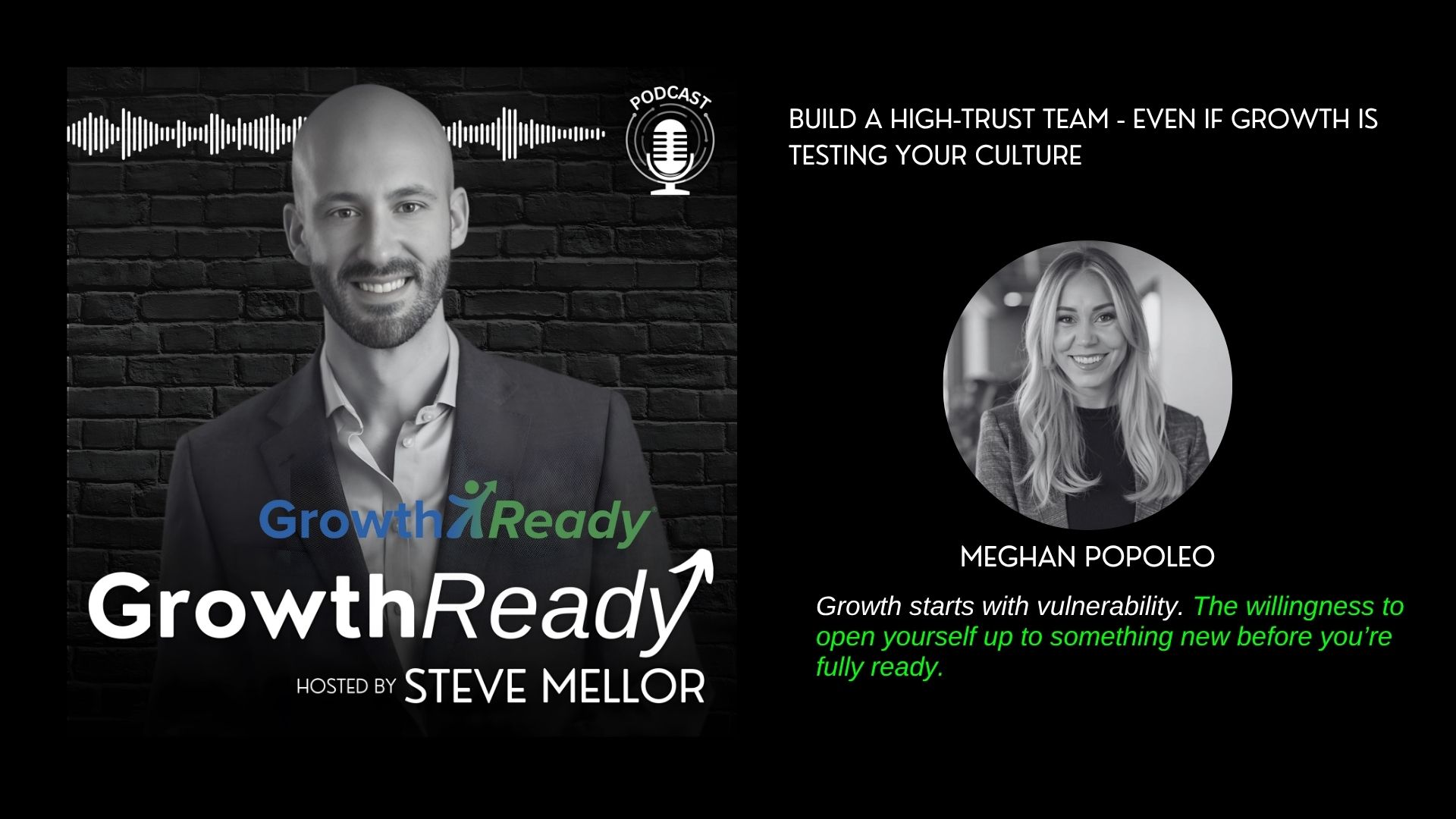
But in my conversation with Meghan Popoleo on GrowthReady, the word that cut through immediately was vulnerability. And the more we unpacked her story, the more obvious it became: real growth does not start when you have everything figured out. It starts when you are willing to step into something meaningful before you feel fully ready for it.
Meghan shared that when she first joined The O’Connor Group, she had come out of nonprofit work, had strong leadership experience, and believed deeply in making an impact. But there was one catch: she was stepping into an HR company while openly admitting she did not even like HR and knew very little about its day-to-day function. That honesty did not cost her the opportunity. It became part of the foundation for it. Marsha O’Connor took a chance on her, Meghan took a chance on Marsha, and ten years later Meghan moved into the president role.
That is not just a nice career story.
That is a leadership lesson.
Because too many people still believe they need to project certainty in order to earn trust. Meghan’s story reminds us that trust is often built another way: through honesty, through self-awareness, and through the willingness to say, “I don’t know this yet, but I’m willing to learn.”
That kind of vulnerability is not weakness. It is a growth strategy.
And it showed up again and again throughout this conversation.
Meghan talked about the relationship she has built with Marsha over the years and what makes that partnership work. Not perfection. Not agreement on everything. Not some polished version of leadership. What sits at the center is the ability to have hard conversations, move through tension, and still protect the relationship in the process. One is highly visionary. The other moves quickly and executes. The strength of the tandem comes from the fact that both perspectives are respected and both are willing to challenge one another when needed.
That matters for any leader reading this.
A strong team is not built by avoiding hard conversations.
It is built by creating enough trust that people can have them well.
That is where culture becomes real.
One of the things I appreciated most in this conversation was how Meghan described the culture at The O’Connor Group. They do not default to “employees.” They talk about teammates. They think intentionally about language. They onboard people through something they call Game Day. They lead with recognition that starts with the person, not just the performance. In Meghan’s words, if someone is struggling personally, the first response is care. The work can wait.
That is not soft leadership.
That is smart leadership.
Because if people do not feel seen, supported, and trusted, they will never give you their best for long. High performance without human recognition is not sustainable. Meghan and Marsha have clearly made the decision to build a business where people matter first — and that decision has shaped how they scale, how they retain talent, and how they protect the culture as the company grows.
I also think there is a powerful lesson here around values.
Meghan spoke about integrity, collaboration, and execution as core values that guide the business. But what stood out to me was not the words themselves. It was the way those values are being protected in real time. That is where leadership gets tested. Anyone can put values on a website. The real question is whether those values still shape decisions when growth gets complicated.
And one of the clearest examples of that came when Meghan shared a deeply personal story.
As succession planning was taking shape and the conversation around her future role was becoming real, she found out she was pregnant with her third daughter. She went to Marsha, had the hard conversation, and told her plainly: I want this opportunity, but I need to be honest about where life is right now. Marsha’s response was not pressure. It was trust. The opportunity would still be there, and the timeline could move in a way that honored both Meghan’s ambition and her season of life.
That is what values in action look like.
And for every working parent, every woman in leadership, and every ambitious professional trying to build something meaningful without abandoning life outside of work, that story matters.
It proves that growth does not have to come at the expense of humanity.
It proves that strong leaders create space, not just pressure.
It proves that loyalty is built when people know they do not have to choose between being fully committed and fully human.
Another insight Meghan brought to the conversation was around relationships. She was clear that relationships have always mattered to her, and that much of her career has been built not by waiting for doors to open, but by reaching out, asking questions, and offering value first. That mindset has shaped how she leads, how she networks, and how she continues to grow.
I think that is especially important right now.
A lot of people want the next opportunity.
Fewer are willing to start the conversation that could lead to it.
Meghan’s example is a reminder that growth often lives on the other side of asking. Asking for insight. Asking for help. Asking for a chance. Asking how you can contribute.
That does not make you needy.
It makes you engaged.
And that same mindset shows up in how she navigates overwhelm. She was honest about being someone who says yes to a lot, takes on a lot, and can easily feel the weight of all she wants to do. But instead of pretending she can carry it all alone, she asks for help. At work. At home. In leadership. In parenting. That, too, is vulnerability. And it is one of the clearest signs of maturity in high performers: not needing to prove you can do everything by yourself.
At the heart of this episode is a message I think GrowthReady listeners need to hear:
Vulnerability is not what slows growth down. It is what opens growth up.
It is what allows you to explore.
It is what allows you to build trust.
It is what allows you to lead people in a way they actually want to follow.
Meghan is helping build a company that is growing through new service lines, stronger leadership structure, and a clear commitment to culture. But what impressed me most was not just the ambition. It was the discipline to keep asking: can we grow without losing who we are?
That is the GrowthReady challenge.
Not just to grow.
But to grow in a way that still looks and feels like you.
If this challenged the way you think about leadership, that is a good thing.
Because growth rarely starts with having all the answers. It starts with the willingness to lead more honestly, communicate more clearly, and build from who you really are.
Book a discovery call if you are ready to strengthen your leadership, build a healthier team culture, and grow with more clarity and conviction.
And listen to the full GrowthReady podcast episode with Meghan Popoleo if you want the deeper conversation behind these insights — the real stories, the leadership lessons, and the mindset shifts that can help you lead better right now.
Don’t just read about growth. Step into it.
CEO of GrowthReady
Olympic swim coach turned high-performance strategist, Steve helps top leaders gain clarity, elevate performance, and lead with purpose. As founder of GrowthReady and host of the GrowthReady Podcast, Steve brings real-world strategies and straight-talk coaching to help you unlock your full potential.
-Featured on top leadership podcasts
-The GrowthReady Podcast Host
-Author of Shock the World: A Competitor's Guide to Realizing Your Potential
-Former Olympic-level coaching expertise applied to executive development
Helping Leaders Expand Their Capacity for Growth Through Learning Loops and Readiness