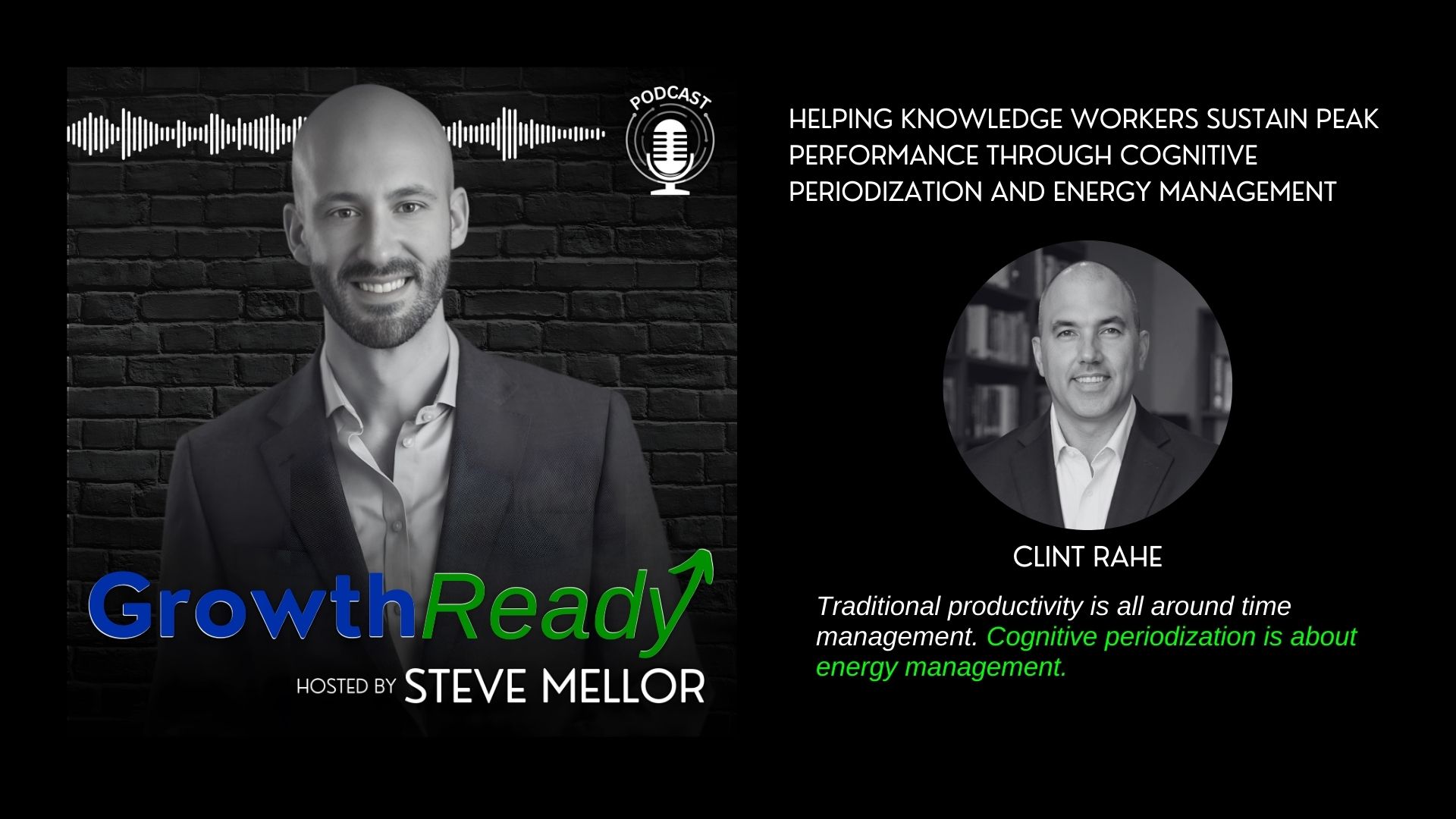
Helping knowledge workers sustain peak performance through cognitive periodization and energy management
Most professionals don’t have a performance problem.
They have an engine management problem.
Because if you use your brain to think, decide, solve, lead, create, delegate, then congratulations… you’re a knowledge worker. And here’s the issue: most knowledge workers are trying to grow using an outdated system, one that treats the brain like it has infinite capacity. It doesn’t.
In a recent episode of GrowthReady, Steve Mellor sat down with Clint Rahe (executive coach and author of The Cognitive Athlete) to unpack why so many high performers feel like they’re constantly “on”… and why that’s exactly what’s breaking them.
The conversation wasn’t fluffy. It was a mirror.
And if you’re leading teams, building a business, or carrying high responsibility—this is the kind of mirror you need.
Growth ready isn’t “do more.” It’s “work with the engine.”
Clint’s definition of being growth ready is simple, and it’s honestly confronting:
Most people are overloaded. Their brains don’t have the capacity to learn, grow, or make great decisions—because they’re operating at capacity all day, every day.
Back-to-back meetings.
No recovery.
Training and development crammed on top of an already full workload.
Always reachable.
Always reacting.
And the result is predictable: burnout, stress, poor habits, poor decisions—not because people are weak, but because their brain is conserving energy and running in survival mode.
Clint’s question cuts through the noise:
Are you upgrading your engine? Are you fueling it? Are you training it like an athlete trains their body?
That’s the shift.
The real goal isn’t constant peak performance. It’s sustainable performance.
Steve and Clint call out one of the biggest lies in corporate culture:
That you’re supposed to be “at your peak” for 30–45 years of your career.
Say it out loud and it sounds ridiculous, yet that’s exactly how people are living.
Clint sees it constantly in senior leaders: late 40s, 50s, C-suite… the stage of life where decision-making should be sharpest. Instead, many are exhausted and burnt out. Some are dealing with autoimmune issues and cardiovascular disease linked to chronic stress.
This isn’t about ambition.
It’s about sustainability.
Because if the cost of your performance today is your health tomorrow… you’re not winning. You’re borrowing.
The missing playbook: cognitive periodization
Athletes don’t train at max intensity every day.
They train in phases.
Clint brings that concept into leadership and knowledge work with a framework he calls cognitive periodization: spreading cognitive load (thinking, decision-making, creativity, recovery) across time—because business has “seasons” even if people pretend it doesn’t.
This is where the conversation gets tactical:
Identify peak moments across your year (major launches, board meetings, strategic cycles, delivery periods).
Build the phases around it: conditioning → performance → transition → recovery.
Stop pretending everything is urgent all the time.
And then Clint hits a point most people miss:
Recovery isn’t a one-week holiday where you crash, get sick, and limp back into work.
He describes the “letdown effect”—where people run at high stress until the break, then their body finally releases and they get hit with illness.
The goal isn’t to go from 100 mph to zero.
The goal is to build active recovery and micro-recovery into your normal week.
Micro-recovery: the five minutes that changes everything
One of the most practical moments in the episode is this:
A difficult conversation at 10:00 AM? That’s a peak moment.
So you prepare.
You perform.
Then you recover, walk, breathe, reset, move your body, before you throw yourself into the next meeting.
Clint references research showing that even five-minute breaks between meetings dramatically reduce stress compared to back-to-back scheduling.
And Steve calls out the truth many people avoid:
It’s not that they don’t know this.
It’s that they don’t own it.
Knowing isn’t the goal. Owning is.
Clint puts ownership into real terms: if it doesn’t connect to what matters most, health, family, presence, the future you want, then it’s just “good information” that changes nothing.
He suggests a simple but powerful exercise:
Write a letter to yourself at 65 about how you want to feel, who you want to be, and what energy you want to have. Then reverse engineer your habits.
Because the truth is:
You can’t out-hack evolution.
And activity alone doesn’t create results.
Clint says it clearly: people confuse movement with progress. Busyness with impact. Shallow work with meaningful work.
High performers don’t just do more.
They do what matters, on purpose.
Protecting the standard: daily planning, daily review, and saying no
Clint shares a simple accountability structure he uses with clients:
15 minutes at the start of the day (blocked as busy) to plan intentionally: what matters, how to show up, where to delegate, what to protect.
End-of-day review: what derailed you, what boundaries need strengthening, what gets adjusted tomorrow.
Use the 80/20 lens to delete tasks that only satisfy the addiction to “being busy.”
And yes, this requires saying no.
Not randomly. Not emotionally.
Strategically, based on the season you’re in, the phase you’re in, and the results you’re committed to.
If you’re reading this and you’re tired, but still ambitious, ask yourself:
Where am I pretending “this is how it has to be”… when it’s really just the story I’ve accepted?
Because there is no rulebook that says your calendar must be chaos.
There is no policy that requires you to sacrifice your nervous system.
There is no badge of honor for burning out on the way to success.
There is only the standard you choose.
CEO of GrowthReady
Olympic swim coach turned high-performance strategist, Steve helps top leaders gain clarity, elevate performance, and lead with purpose. As founder of GrowthReady and host of the GrowthReady Podcast, Steve brings real-world strategies and straight-talk coaching to help you unlock your full potential.
-Featured on top leadership podcasts
-The GrowthReady Podcast Host
-Author of Shock the World: A Competitor's Guide to Realizing Your Potential
-Former Olympic-level coaching expertise applied to executive development
Helping Leaders Communicate With More Power and Presence Through Embodied Readiness