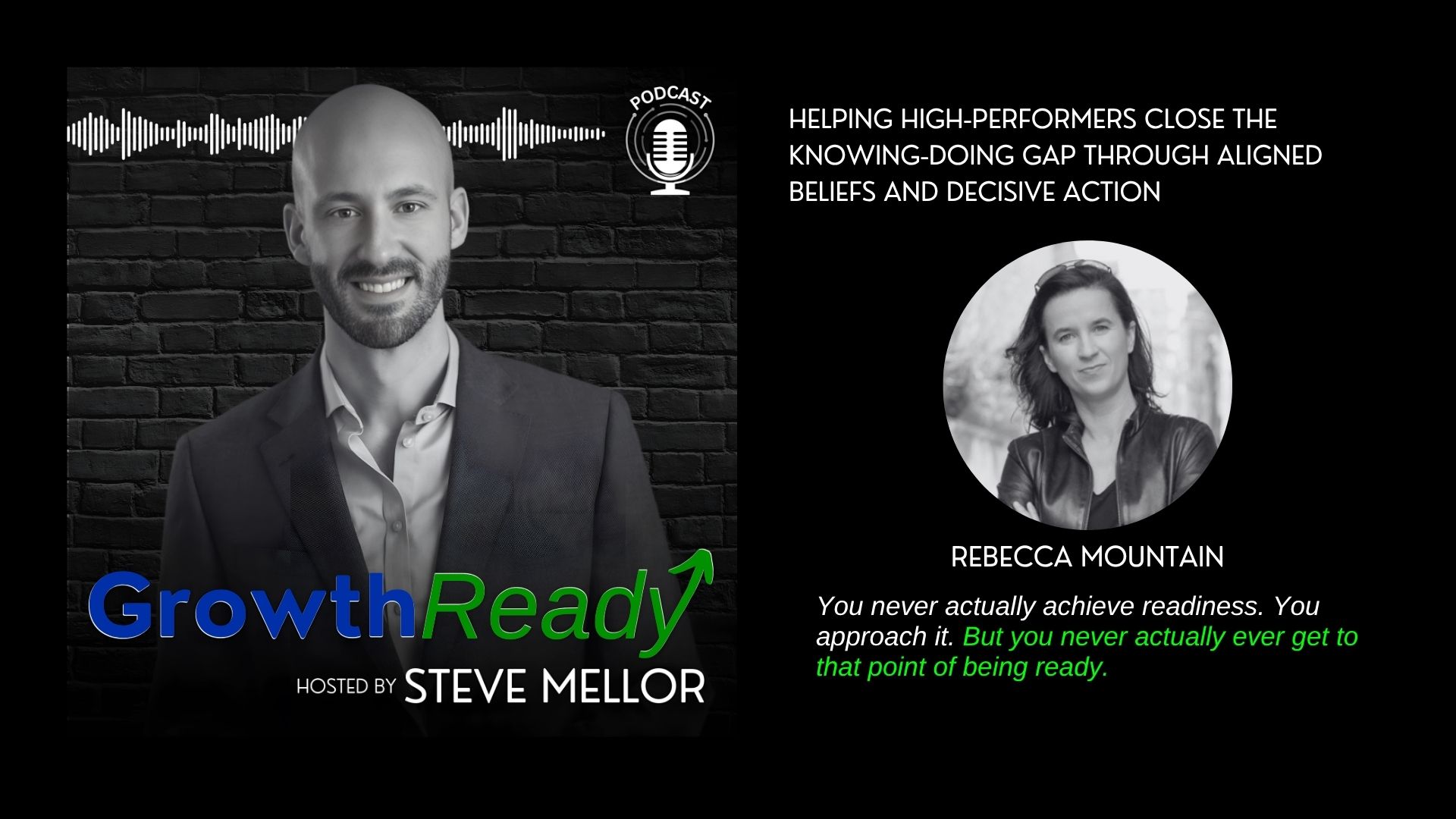
Helping High-Performers Close the Knowing-Doing Gap Through Aligned Beliefs and Decisive Action
There are some podcast conversations that inspire you.
And then there are conversations that confront you.
This one did both.
On GrowthReady, I sat down with Rebecca Mountain, and from the very first question, she challenged the way most people think about readiness. Her perspective was powerful: readiness is not something you fully arrive at. You do not wake up one day and suddenly become “ready.” You are either approaching readiness, or you are doing. And sometimes, what people call readiness is really just a more acceptable word for delay.
That landed hard.
Because if we are honest, a lot of talented people are not stuck because they lack ability. They are stuck because they are waiting for a feeling that may never fully come.
More confidence.
More clarity.
More certainty.
More proof.
But growth rarely works that way.
Rebecca’s story is one of the strongest examples of that I have heard. She spent years inside a cult she had entered as a child, eventually reaching a point where she knew the life she was living was unsafe, unhealthy, and deeply misaligned. But even then, leaving was not simple. It was layered with fear, programming, uncertainty, and the belief that stepping away would lead to destruction. What changed was not that she suddenly felt perfectly ready. What changed was that a catastrophic car accident forced a different question to the surface:
What if they were wrong?
That question became a turning point.
And I think that matters far beyond Rebecca’s story.
Because every high-performer has some version of that moment — a point where the familiar may still feel safer than the unknown, even when the familiar is quietly crushing them. A point where they know something has to change, but they do not yet trust themselves enough to move. A point where staying still has become easier than facing the effort required to pull themselves out.
That is where this episode goes deeper than motivation.
Rebecca made it clear that excuses are rarely random. They are built out of fear, emotional programming, and the stories we keep telling ourselves about why now is not the time. But she also made something else clear: those excuses lose power when you build even the smallest seed of self-trust.
That phrase stayed with me.
Because for so many people, growth is not blocked by a lack of talent. It is blocked by the absence of trust in their ability to figure it out.
That is why this conversation matters so much for leaders, entrepreneurs, and anyone trying to make a meaningful change in their life or work.
Rebecca’s coaching framework is built around helping people close what she calls the knowing-doing gap — that frustrating space where you know what to do, but you still are not doing it. And what I appreciated most was that she did not reduce that gap to laziness, poor discipline, or a lack of information. She treated it like what it really is: a human problem that requires emotional awareness, aligned beliefs, decisive action, and high-performance habits.
That is a GrowthReady message if there ever was one.
Because too many people think the answer is just more information.
Another book.
Another podcast.
Another strategy.
Another idea.
But Rebecca said something every high-performer needs to hear:
Knowing is not enough.
If what you know is not translating into how you act, then something deeper is in the way. And more information will not fix a gap that is emotional, behavioral, or identity-based.
That is where her framework becomes so valuable.
First, she talks about aligned beliefs — understanding what you feel, what you think, and what actually makes you happy enough to protect. Then she moves into decisive action — not random movement, but action tied to clarity around who you serve, what matters most, and what work should stay on your plate versus what needs to be automated, delegated, outsourced, replaced, or eliminated. Then comes the third pillar: high-performance habits — clarity, energy, courage, productivity, influence, and necessity.
This is where I think a lot of people listening to GrowthReady will feel seen.
Because there is a big difference between being busy and being aligned.
There is a big difference between wanting change and becoming the kind of person who can sustain it.
And there is a huge difference between trying harder and understanding what is actually creating resistance in the first place.
One of the strongest parts of the conversation for me was Rebecca’s point that if something feels hard, that does not automatically mean you are on the wrong path. In fact, courage often looks like doing it because it is hard. Not waiting for the fear to disappear. Not convincing yourself that discomfort means danger. But recognizing that difficulty can be evidence that you are finally doing real growth work.
That is such an important reframe.
Especially for people who are used to reading discomfort as a stop sign.
Sometimes discomfort is not the warning.
Sometimes it is the invitation.
Rebecca also spoke about the role of emotions in performance in a way I think many leaders need to hear more often. She pointed out that emotions are not the enemy. They are not weaknesses to suppress. They are data. They shape decisions, focus, behavior, and follow-through. And if you do not understand the emotional patterns behind your hesitation, avoidance, or inconsistency, you will keep hitting the same wall no matter how smart you are.
That is coaching work.
Not just telling someone what to do.
But helping them see why they are not doing what they already know.
That is why this episode stood out to me.
Rebecca is not just helping people set bigger goals. She is helping them develop the internal structure to actually move toward those goals without getting trapped by old excuses, emotional noise, or self-sabotaging patterns. She is helping people stop waiting for readiness and start practicing it in motion.
And that is the challenge I would leave with every reader:
What are you still calling “not ready” that is actually just fear in a smarter outfit?
What if the version of you that is waiting for certainty is the very thing slowing down your growth?
What if the next step is not to feel ready — but to trust yourself enough to move anyway?
That is what this conversation asks of us.
Not perfection.
Not false confidence.
Not blind optimism.
Just enough honesty to stop hiding behind preparation and enough courage to close the gap between what we know and what we do.
That is where growth begins.
If this conversation hit a nerve, that is probably a sign.
A sign that you already know more than enough.
A sign that the next step is not more information — it is action.
Book a discovery call if you are ready to close the gap between what you know and how you show up.
And listen to the full GrowthReady podcast episode with Rebecca Mountain if you want the deeper conversation on self-trust, excuses, emotional resilience, and what it really takes to move before you feel fully ready.
Stop waiting for readiness. Start approaching it with intention.
CEO of GrowthReady
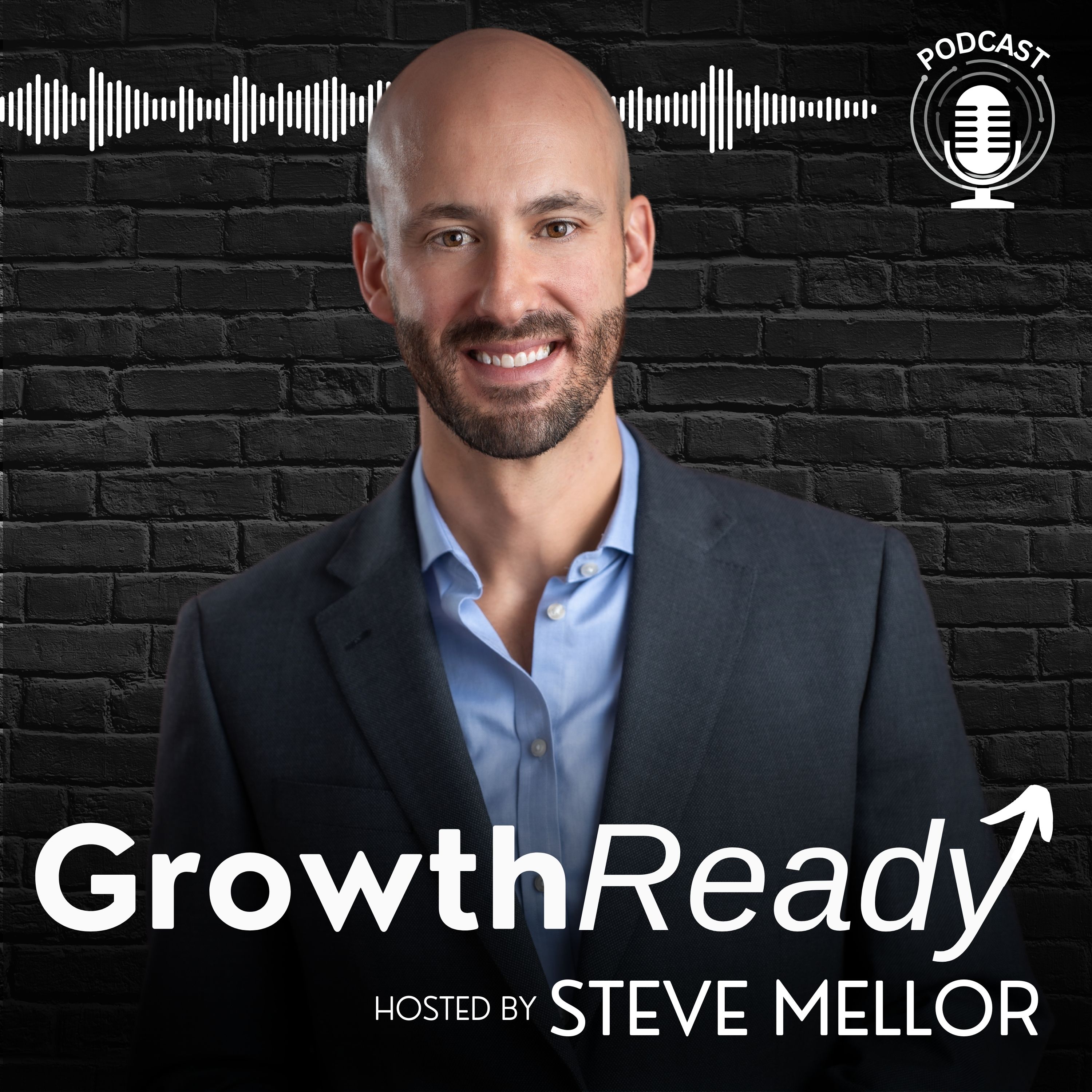
Olympic swim coach turned high-performance strategist, Steve helps top leaders gain clarity, elevate performance, and lead with purpose. As founder of GrowthReady and host of the GrowthReady Podcast, Steve brings real-world strategies and straight-talk coaching to help you unlock your full potential.
-Featured on top leadership podcasts
-The GrowthReady Podcast Host
-Author of Shock the World: A Competitor's Guide to Realizing Your Potential
-Former Olympic-level coaching expertise applied to executive development
Helping Leaders Expand Their Capacity for Growth Through Learning Loops and Readiness